High-pressure water jet cutting production line for green onions

In large-scale scallion processing scenarios, the combination of industrial cameras for automatic recognition and high-pressure water jet cutting is the core technical solution for achieving “precise, automated, and standardized” production.
I. Core Components: Visual Recognition + Automated Waterjet Cutting System
1. Industrial Camera Visual Recognition Unit
Hardware Configuration: Employs a high-resolution industrial area scan camera covering the entire conveyor belt width, ensuring real-time capture of the scallions during rapid transport; also equipped with a dustproof and waterproof housing.
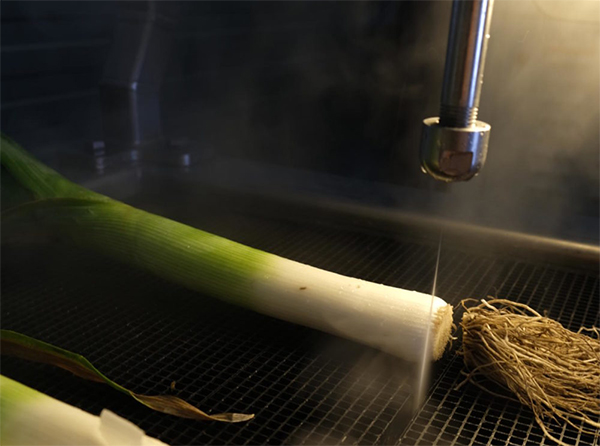
2. High-Pressure Waterjet Automatic Cutting Unit
High-Pressure Power System: Food-grade high-pressure pump, paired with a pure water filtration device, ensuring the cutting water is free of impurities and pollution; uses sapphire nozzles, resistant to high pressure and wear-free.
Intelligent Actuator: Multi-axis servo motor-driven cutter head module, enabling parallel cutting; the conveyor belt is made of food-grade PU material, equipped with a variable frequency speed control system, synchronized in real-time with the cutter head movement speed. Control System: PLC main controller (supports Modbus/TCP communication protocol)
3.Linkage Auxiliary Units
II. Working Principle: A Closed-Loop Process from “Visual Recognition” to “Automatic Cutting”
1. Pre-processing: Clearing Obstacles for Visual Recognition
After the scallions are cut at the root and high-pressure washed, they are conveyed at a uniform speed to the recognition area via a flexible conveyor belt. At this time, guide plates on both sides of the conveyor belt gently straighten the scallions, ensuring they are arranged in a single row and dispersed, avoiding overlap and obstruction; simultaneously, the LED light source is turned on, evenly illuminating the surface of the scallions, eliminating shadows and reflections, and ensuring clear images captured by the camera.
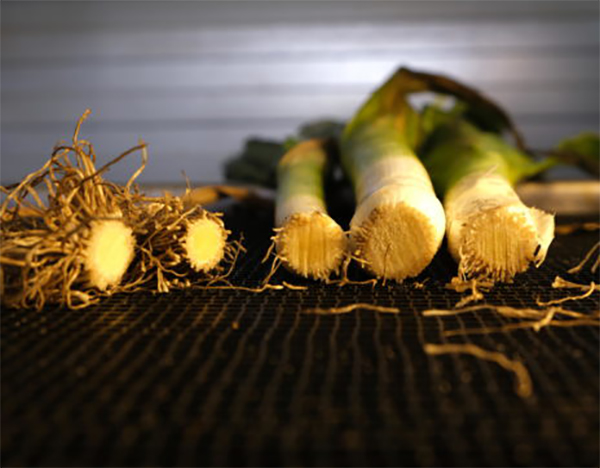
- Visual Recognition: Precisely Capturing All-Dimensional Information of Scallions Image Acquisition: Industrial cameras continuously capture images of scallions on the conveyor belt at a preset frequency;
Image Preprocessing: Vision software performs grayscale conversion, noise reduction, and enhancement on the acquired images, filtering out background (conveyor belt, guide plate) and minor impurities to highlight the contour features of the scallions; Feature Extraction and Analysis: Automatically identifies key information of the scallions through a customized algorithm;
3.Automatic Cutting: Dynamic Following + Precise Execution
The water jet pressure is automatically adjusted according to the diameter of the scallion to ensure smooth cutting without damaging the scallion;
Dynamic Trajectory Planning: For scallions being conveyed, the system uses kinematic algorithms to calculate the synchronous following trajectory of the cutter head—the cutter head maintains the same speed as the scallion along the X-axis, while simultaneously cutting along the Y-axis at preset intervals, achieving “dynamic tracking cutting” and avoiding cutting deviation caused by conveyor speed;
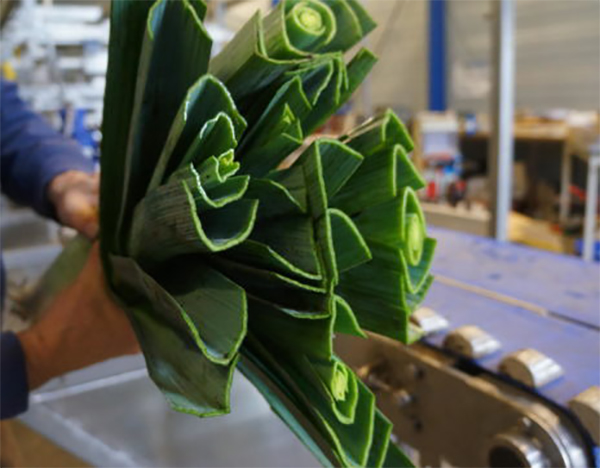
III. Adapted Scenarios and Customized Solutions
Large-scale pre-processed vegetable plants: Require large-scale, standardized production, suitable for fresh food delivery and supermarket supply;
Food deep-processing enterprises: Used for cutting scallions as an ingredient in convenience foods;
Central kitchens of restaurant chains: Require standardized ingredient specifications to improve cooking efficiency and consistency of dishes;
Agricultural cooperatives: Enable refined post-harvest processing of scallions to increase product added value.