Why are food waterjet cutting machines suitable for the fine processing of cakes and chocolates?

In the field of baking and processing, cakes and chocolates are notoriously difficult to cut due to their sensitive structure, stringent quality requirements, and the challenge of controlling raw material waste. Many baking factories frequently encounter problems such as chipped edges, misaligned layers, material waste, and substandard quality control. The core reason is not operational error, but rather the incompatibility between traditional cutting techniques and the physical properties of these two types of ingredients. I will analyze, in conjunction with the characteristics of these ingredients and mass production standards, the core reasons why food waterjet cutting machine is more suitable for the processing of cakes and chocolates.
Cakes and chocolates have vastly different physical structures, demanding stringent cutting techniques. Traditional knives and ultrasonic cutting methods have significant limitations. Mousse and multi-layered cakes have a soft, porous colloidal structure, making them prone to sticking, easily deformed and collapsed under pressure. Pure chocolate and filled chocolate slabs have a low-temperature brittle crystalline structure, making them brittle and hard; uneven pressure can cause them to chip and crumble, and they easily melt and spoil when heated. Both types of ingredients share a common core cutting requirement: no compression, no contact, no temperature rise, and high precision—technical shortcomings that traditional equipment struggles to overcome.
Traditional cutting techniques are a major bottleneck for improving the quality and efficiency of mass production in baking. Manual and mechanical cutting relies on physical extrusion, which easily leads to cake cream sticking together, layering shifts, and edge collapse, resulting in large dimensional deviations in the finished product. Subsequent trimming significantly increases material waste. While ultrasonic cutting improves flatness, the high-frequency vibration generates micro-heat, easily causing the chocolate surface to melt and become sticky. The vibration impact can also cause thin chocolates to break, making high-precision, irregularly shaped cuts impossible. Furthermore, metal blades are prone to wear and bacterial growth; frequent cleaning and replacement delays production, pose food safety risks, and are ill-suited to the standardized, large-scale production demands of high-end baking.

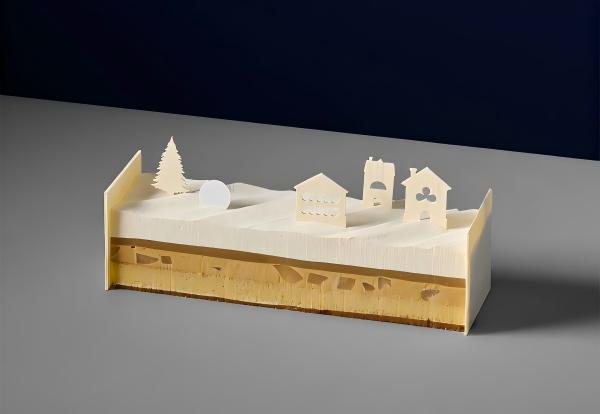
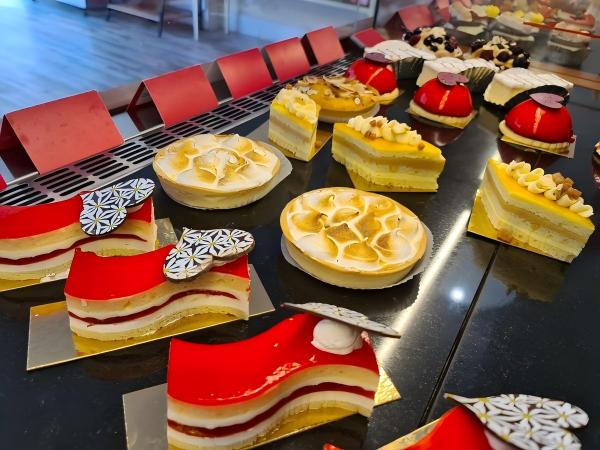
Food-grade waterjet cutting relies on room-temperature pure water non-contact cold cutting technology to fundamentally solve the cutting problems of cakes and chocolates, adapting to the processing characteristics of these two types of ingredients. The equipment uses ultra-fine high-pressure pure water to complete the cutting process, with no blade contact or physical compression throughout. When processing multi-layered cakes, it can completely preserve the layered structure of the cake base and cream, resulting in clean, flat cut surfaces without collapse or detachment. The finished products are precisely and uniformly sized, requiring no secondary manual trimming.
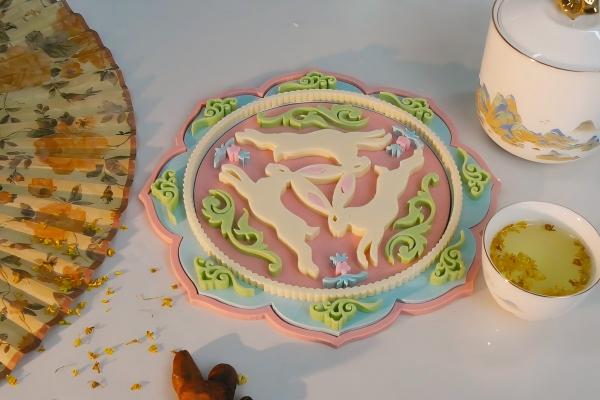
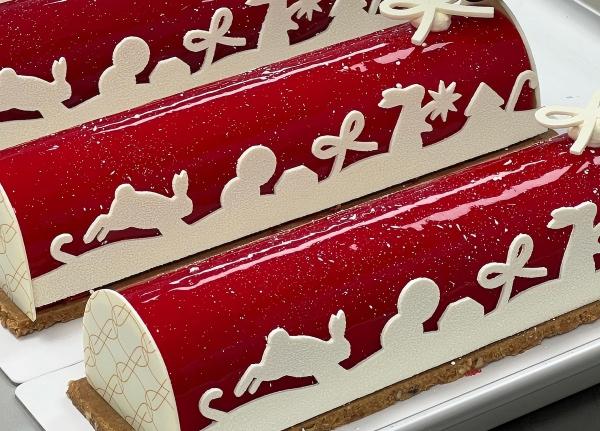
Food waterjet cutting operates entirely at room temperature, eliminating any temperature rise or heat conduction, thus avoiding problems such as melting, stickiness, and discoloration during chocolate cutting. Whether it’s hard chocolate slabs, ultra-thin chocolate chips, or complex hollowed-out irregularly shaped chocolates, it can achieve cuts without chipping, crumbling, or cracking, resulting in smooth and uniform cuts that fully preserve the original crystalline texture of the chocolate, enhancing the appearance and market value of high-end desserts.
In addition, food-grade waterjet cutting boasts significant advantages in terms of low material loss and high hygiene. The waterjet cutting produces extremely fine kerfs with virtually no material loss, effectively reducing the production costs of high-end baking ingredients. The entire process uses food-grade pure water, eliminating media residue and cross-contamination, thus preventing bacterial growth issues associated with metal knives and meeting food safety production and export quality inspection standards. Coupled with an intelligent CNC system, it can flexibly switch between standard slab cutting and irregular shape cutting, accommodating both new product development and mass production, offering superior flexibility compared to traditional cutting equipment.
Today, the baking industry has moved beyond extensive mass production and is upgrading towards refinement, standardization, and high-end products. Consistent quality, low waste, and high safety have become core competitive advantages for baking companies. Whether it’s a small or medium-sized baking plant or a large central kitchen, waterjet cutting machines are the perfect equipment for processing cakes and chocolates. They effectively address the pain points of traditional processes, such as poor product appearance, high waste, substandard hygiene, and limited production capacity, providing a reliable solution for improving quality, reducing costs, and upgrading processes in the baking industry.